

TL;DR
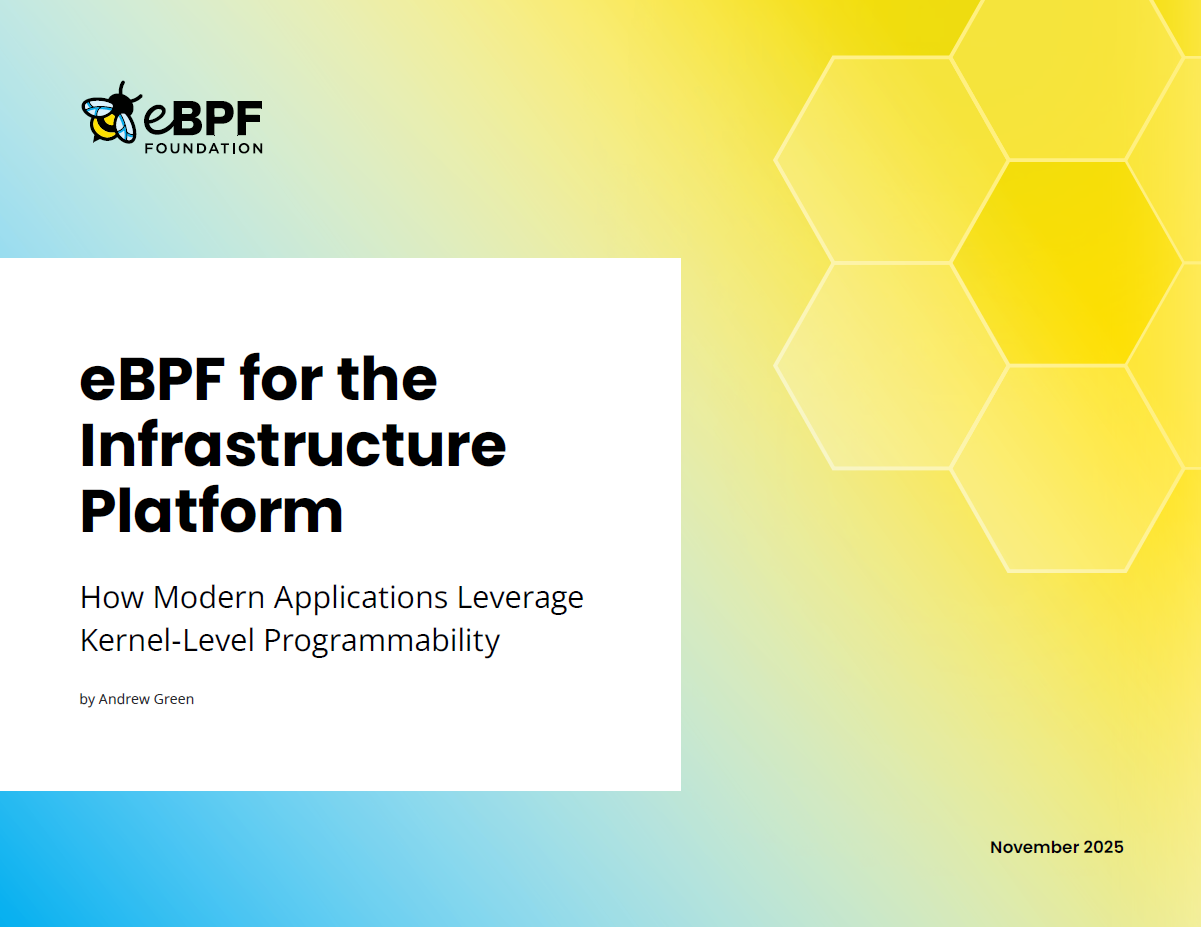
New eBPF Foundation research shows that eBPF has become the strategic platform of choice for infrastructure teams across networking, security, observability, FinOps, and AI/LLM workloads. The eBPF for the Infrastructure Platform report explains how organizations are replacing legacy agents and kernel modules with faster, safer, more programmable eBPF-based solutions, highlights real world benefits adopters have seen, and provides guidance for adopting eBPF across cloud, on-prem, and hybrid environments. This report is now available for free download.
FOR IMMEDIATE RELEASE
Latest analysis from the eBPF Foundation examines how eBPF building blocks have become the strategic platform of choice for infrastructure teams
SAN FRANCISCO – December 3, 2025 – The eBPF Foundation, which advances eBPF’s upstream development and community and promotes its secure adoption across platforms, today announced the availability of its newest research report, eBPF for the Infrastructure Platform: How Modern Applications Leverage Kernel-Level Programmability. This qualitative study provides an in-depth exploration of how eBPF has evolved into a foundational technology for today’s cloud native, on-prem, and AI-driven infrastructure environments.
The report captures how eBPF is transforming product categories including cloud and on-prem observability, network and runtime security, FinOps, LLM observability, and virtualized networking. It explains why infrastructure teams, from hyperscalers to SMBs, are increasingly standardizing on eBPF as the build block to gain deeper visibility, improve performance, and replace legacy tooling with more flexible and efficient kernel-level programs.
“eBPF has moved far beyond its early adopter phase,” said Bill Mulligan, eBPF Foundation Governing Board Member from Isovalent. “Today, it underpins some of the most advanced infrastructure platforms in the world. This report highlights not only how far the technology has come, but also how its trajectory is reshaping security, networking, observability, and AI infrastructure across industries.”
Key Insights From the Report
Drawing on interviews, industry analysis, and examples from organizations such as Meta, Netflix, Cloudflare, and others, the report outlines several major trends shaping the future of eBPF:
- eBPF is redefining product categories, replacing legacy agents, sidecars, and kernel modules with secure, low-overhead kernel-native functionality across networking, security, and observability.
- Infrastructure teams are converging on eBPF as a strategic platform, using it to optimize performance, reduce operational overhead, and reprogram system behavior without modifying kernel source code.
- AI and LLM workloads rely on eBPF for high-fidelity telemetry, enabling better inference, workload optimization, and resource efficiency for large-scale compute clusters.
- Developer tooling is accelerating adoption, making eBPF accessible beyond kernel experts through SDKs in multiple languages, IDE integrations, debugging tools, and CO-RE (Compile Once–Run Everywhere) frameworks.
The report also provides practical guidance on how organizations can adopt eBPF today, including evaluating open source projects such as Cilium, Tetragon, and OpenTelemetry; assessing commercial distributions; and determining when to build custom eBPF programs internally.
“A Platform Shift for Infrastructure”
The report concludes that eBPF has become the building block for a new generation of modular infrastructure platforms. Just as early eBPF tools solved single problems at hyperscale companies, today’s eBPF-based solutions combine networking, security, observability, and AI-aware telemetry into integrated platforms that adapt in real time to modern application demands.
Download the Report
eBPF for the Infrastructure Platform is available to download for free from the eBPF Foundation.
eBPF Foundation Resources
- Learn about membership opportunities
- Subscribe to the mailing lists
- Access other resources on eBPF’s GitHub or Slack
About the eBPF Foundation
The eBPF Foundation was created to advance eBPF as an open, shared technology for programmable infrastructure. It brings together a cross-platform community of maintainers and organizations working upstream to evolve eBPF’s capabilities while ensuring its safety, security, and performance. Foundation members collaborate on common technical priorities, security best practices, community development, and promotional opportunities supporting eBPF across kernels, operating systems, and enterprise environments. Find further information here: https://www.ebpf.foundation